Updated
A Riello burner lockout means the control has stopped the burner because a required operating or safety condition was not met. The cause can be fuel supply, ignition, flame detection, airflow, a valve circuit or the control itself. The useful starting point is the stage at which it stopped and the diagnostic signal on the fitted control.
This guide covers oil, gas and dual-fuel examples, with separate references for 530SE, RMO, RMG, MO550, digital Gulliver controls, LFL, REC27 and LME71. Match the control-box label before using a fault table.
Before restarting
Record the code and stopping stage. If there is a fuel leak, gas smell, smoke or accumulated unburned fuel, leave the burner stopped. Do not repeatedly reset it or bypass flame, pressure or safety interlocks. Electrical tests, fuel-pressure measurements and combustion adjustment require a qualified burner technician.
Start with the stopping stage
Record the burner model, control-box reference, selected fuel and displayed code. A short video captures blink counts, alternating colours and the point at which the fan, ignition and flame stop. The Riello model-number guide explains the nameplate and suffixes.
Swipe the table to see all columns →
| Observed stage | Investigate first | Typical component paths |
|---|---|---|
| No fan or motor movement | Heat demand, electrical supply and safety circuit | Thermostat or pressure-switch circuit, base connections, motor circuit |
| Fan runs; sequence does not advance | Air proving or position confirmation on gas burners; start-circuit conditions on 530SE oil burners | Pressure switch and tube, damper actuator, photocell or valve-coil circuit |
| Purge ends; no flame appears | Fuel delivery and ignition | Oil nozzle/pump/valve, gas valve, electrode, lead or transformer |
| Flame appears, then lockout | Flame stability and flame detection | Photocell or ionisation circuit, fuel pressure, combustion setting |
| Low fire works; high-fire transition fails | Second-stage demand, fuel delivery and air movement | Second-stage valve, hydraulic cylinder or actuator |
| Burner trips after running | Changing fuel pressure, flame signal or safety inputs | Supply restriction, detector connection, fan/pressure circuit |
A burner waiting for heat demand or a fuel-pressure permissive is not necessarily in lockout. Likewise, repeated starts caused by a pressure switch opening need a different investigation from a latched flame-failure alarm.
Oil burners: 40 G, Gulliver RG and RL
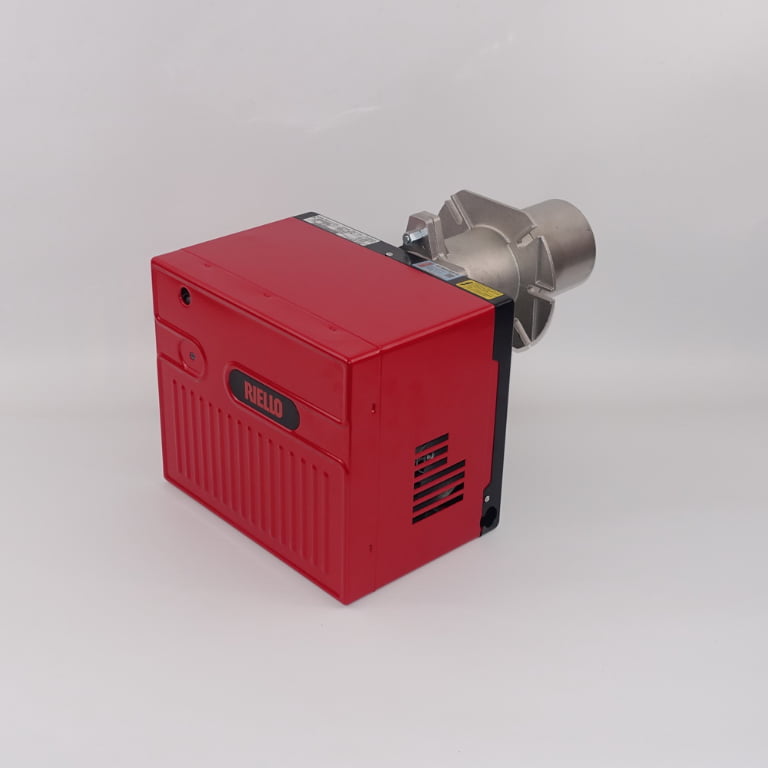
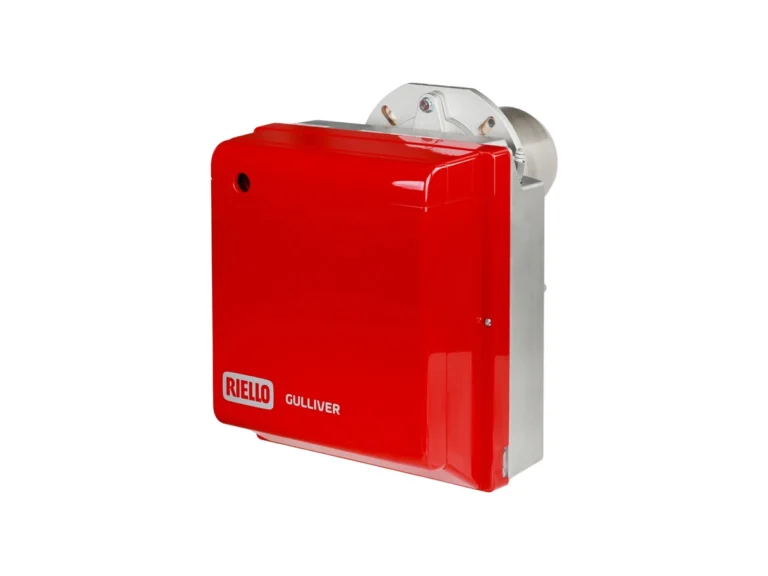
40 G5 with 530SE: follow the start sequence
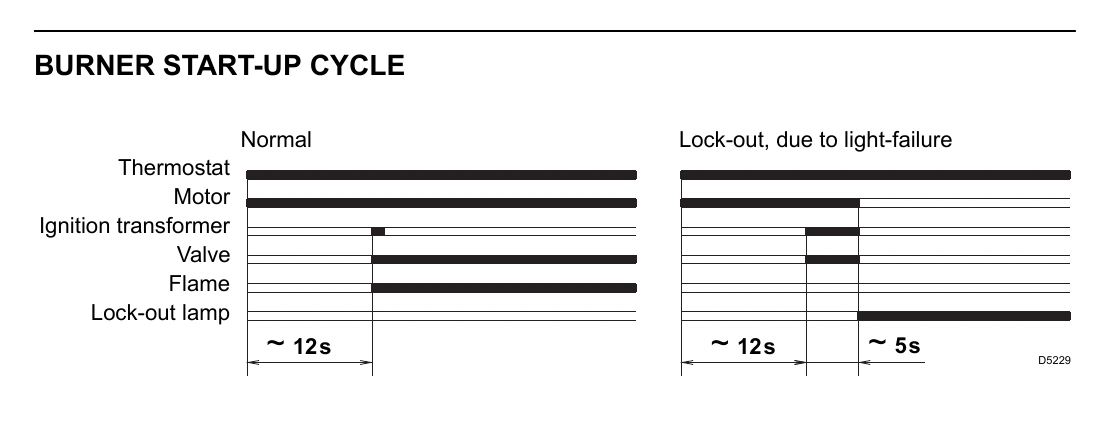
The G5 manual shows the motor starting before ignition and flame establishment. Its example has approximately 12 seconds before flame establishment and a 5-second safety interval when ignition fails. These timings belong to this G5/530SE manual, not every Riello burner.
- No motor movement: establish whether heat demand and the safety circuit are present, then inspect supply, base connections and the motor circuit.
- Motor runs continuously, with no firing and no lockout: Riello’s R40/Mectron FAQ directs attention to the photocell, oil-valve coil and motor auxiliary supply before condemning the 530SE.
- Purge completes but no flame forms: separate lack of oil delivery from lack of ignition. Check fuel supply, pump priming, nozzle condition, valve operation and the ignition circuit.
- Flame appears and then the burner locks out: check whether the flame is stable and whether the photocell can detect it. A dirty viewing path and a failed detector are different faults.
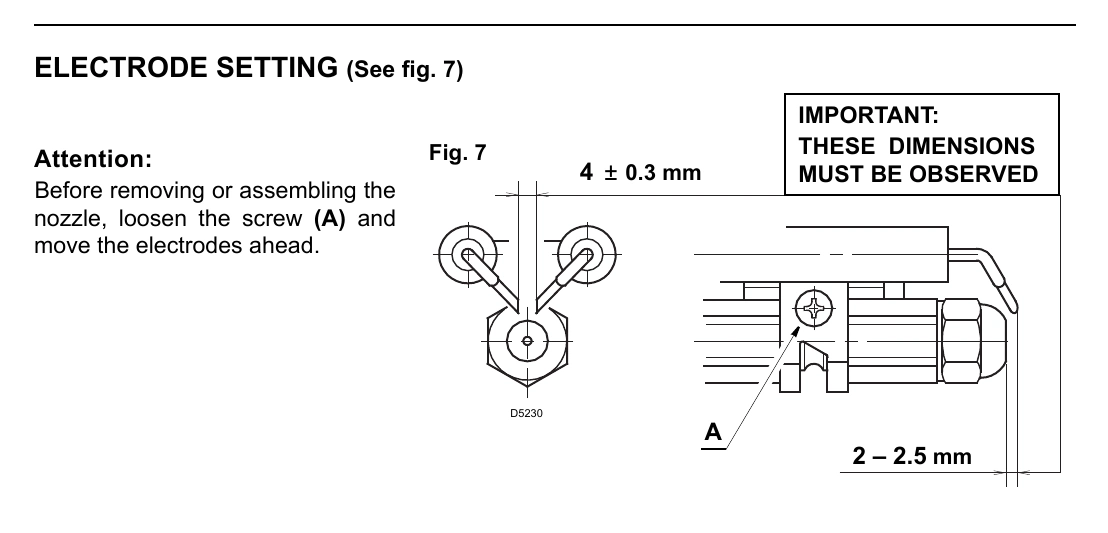
For an ignition fault, electrode geometry matters as much as the transformer. The G5 drawing specifies a 4 ± 0.3 mm electrode gap and a 2–2.5 mm positioning dimension. Use the drawing for this head rather than transferring these dimensions to another burner.
Once a failed control has been confirmed, see the 530SE control-box page. For a nozzle, electrode, coil or motor enquiry, use the 40 G5 product page and send the component reference.
Gulliver RG3D: distinguish the control generation
In the earlier RG3D manual 2901951 rev.19, a lockout shortly after ignition calls for checks of the photocell, oil pressure and delivery, air setting, first-stage valve and nozzle. First determine whether flame never appeared or appeared but was not proved.
The later digital RG2D/RG3D/RG4D/RG5D manual uses timed colour signals. A steady red light, fast red flashing and alternating red/green indicate different conditions. Use the digital RGD table below when that control and manual match the burner. A model name alone does not identify the diagnostic system.
RL 190: failed ignition, unstable oil pressure and high-fire faults
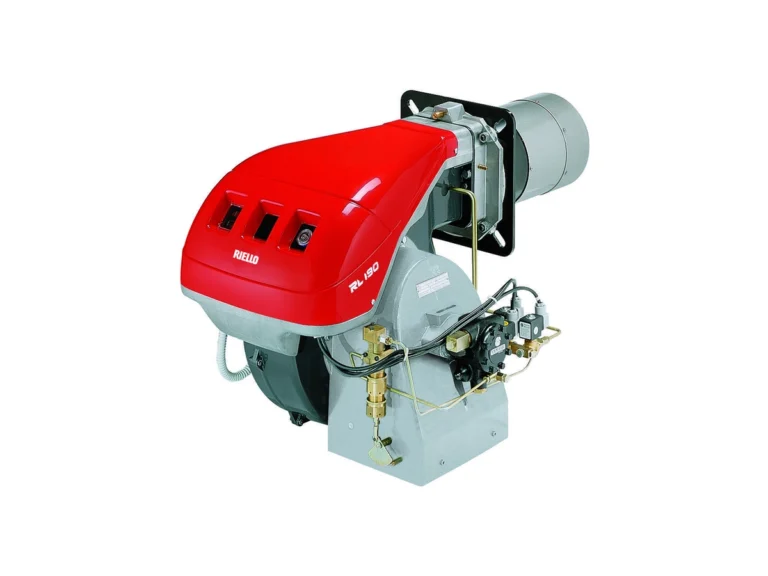
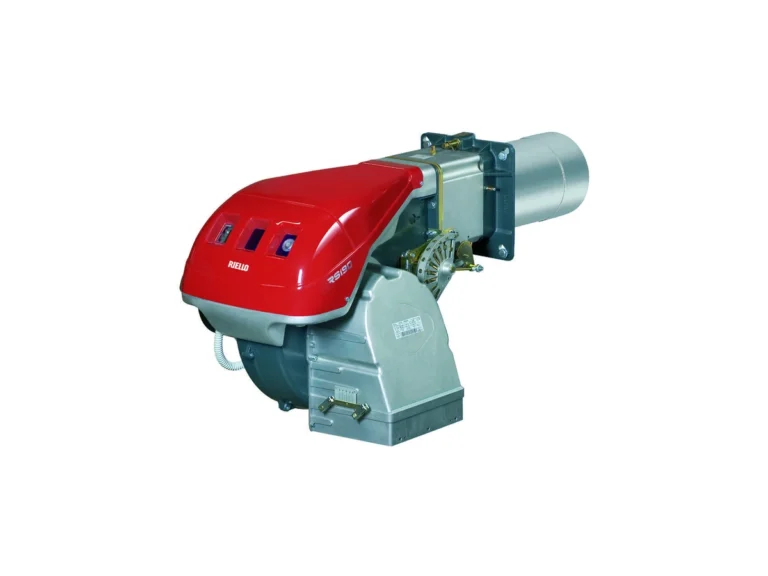
On the RL 190 with RMO88.53A2, two flashes direct the investigation toward failure to establish flame. The manual includes empty or contaminated fuel, an unprimed pump, a blocked supply or filter, valve faults, nozzle faults and ignition faults. A new control box will not correct any of those supply problems.
A noisy pump or fluctuating pressure calls for inspection of suction leaks, restrictions, filters, tank level and pipe layout before replacing the pump. If low fire works but high fire does not, check the high-fire demand, second-stage valve circuit, oil pressure and hydraulic or damper movement. Failure to reach high fire and an actual lockout are separate observations.
For confirmed nozzle, pump, coil or actuator faults, use the RL 190 product page to identify the burner and request the component. The RMO table separates ignition, false-light and running-flame faults.
Gas burners: airflow, ignition and flame proving
The RS 190 provides a useful RMG-controlled example. Its manual uses ionisation flame detection. An oil-burner photocell is not the replacement for that ionisation probe.
- Fan starts, then three flashes: investigate airflow proving. Inspect the pressure switch’s rest and operating states, sensing tube, fan, motor and thermal protection. A running fan does not establish that the pressure switch has received the required pressure.
- Purge completes, then two flashes without flame: check gas pressure while the valves open, valve actuation, ignition-electrode insulation and position, high-voltage lead and transformer.
- Flame appears, then seven flashes: inspect flame stability, ionisation-probe position and insulation, connections, earthing and phase/neutral arrangement.
- Repeated starts without a latched code: watch the minimum-gas-pressure condition as the valve opens. A pressure collapse can interrupt the start and cause recycling.
The RS 190 manual specifies a minimum ionisation current of 5 µA for its detection circuit. Other controls and detector types have different limits; use their own manuals when measuring flame signal.
A pressure-switch trip is evidence of an unsatisfied pressure condition, not proof that the switch is defective. Check the actual pressure and switch response before choosing a replacement. For ignition probes, gas-valve coils, filters and pressure switches, the RS 190 page provides the burner reference for a parts enquiry.
RLS dual-fuel burners: separate the two fuel circuits
Record whether the fault occurs on oil, gas or both. The RLS 68/120 M MX manual provides separate oil and gas fault tables. A useful diagnostic approach is to start with the circuit that fails, then examine the shared functions.
Swipe the table to see all columns →
| Fault pattern | First diagnostic direction |
|---|---|
| Oil works; gas fails | Gas supply and dynamic pressure, pressure permissives, gas-valve and ignition circuits |
| Gas works; oil fails | Tank and suction line, pump and coupling, oil valves, nozzle and oil-firing settings |
| Both fuels fail at the same stage | Supply and safety circuit, shared fan/air movement, ignition and flame-control functions |
| Failure only during a load change | Fuel-specific delivery and the corresponding air/fuel movement |
On the oil side, suction leaks and restrictions can produce unstable pump operation. On the gas side, pressure loss when the valves open can interrupt the starting sequence. During a load change, relate the fault to fuel delivery, air movement and flame signal rather than replacing the shared control first.
For another published dual-fuel model, see Riello RLS 100. Use its own technical documentation for settings and component selection; the RLS 68/120 M MX examples here do not establish identical controls or parts across the RLS range.
Riello controller fault codes: choose the matching table
Record the full control reference before reading a code. RMG and RMO flash counts, RGD colour timings, LFL dial symbols and REC27/LME71 numeric displays are different systems. A shared number does not establish a shared fault.
RMG on RS 190: red-light flash counts
This table follows RS 190 manual 2915943 rev.16. Read the repeating diagnostic group, not the normal start-up light sequence.
Swipe the table to see all columns →
| Red flashes | Meaning / check direction |
|---|---|
| 2 | Flame not established by the end of the safety time. Check gas delivery, valve operation and ignition. |
| 3 | Air-pressure supervision is not satisfied. Check switch state, actual airflow, sensing tube and motor protection. |
| 4 | Unwanted flame signal or flame remaining after shutdown. Investigate actual residual flame and the detection/control circuit. |
| 7 | Lockout after ignition, during a load change or following flame loss. Check combustion stability and ionisation proving. |
| 10 | Wiring, control-box or electrical-interference fault. Inspect connections and interference before replacing the control. |
RMO88.53A2 on RL 190
Swipe the table to see all columns →
| Red flashes | Meaning / check direction |
|---|---|
| 2 | No flame established within the safety time. Check oil delivery, atomisation, valve operation and ignition. |
| 4 | Photocell short circuit or unwanted light/flame signal. Inspect the cell, connection and light conditions. |
| 7 | Flame detachment or loss during operation. Check nozzle, oil pressure, head/air setting and detector. |
| 10 | Connection, internal-control or interference fault. Check wiring and interference sources. |
MO550: BGK3 manual reference
Swipe the table to see all columns →
| Red flashes | Meaning / check direction |
|---|---|
| 2 | Flame not stable by the end of the safety time. Check detector, oil valve, ignition and burner adjustment. |
| 4 | Unwanted light signal during starting, stopping or purge. Check stray light, residual flame and detection. |
| 7 | Flame lost during operation. Check oil delivery, valve operation, detector and combustion stability. |
| 8 | Oil-heater or thermostat monitoring fault on versions fitted with an oil heater. |
Digital RG2D/RG3D/RG4D/RG5D: colour and timing
The timing is part of the signal. In the table, “on/off” means a single colour switches on and off; “alternating” means the two colours follow one another.
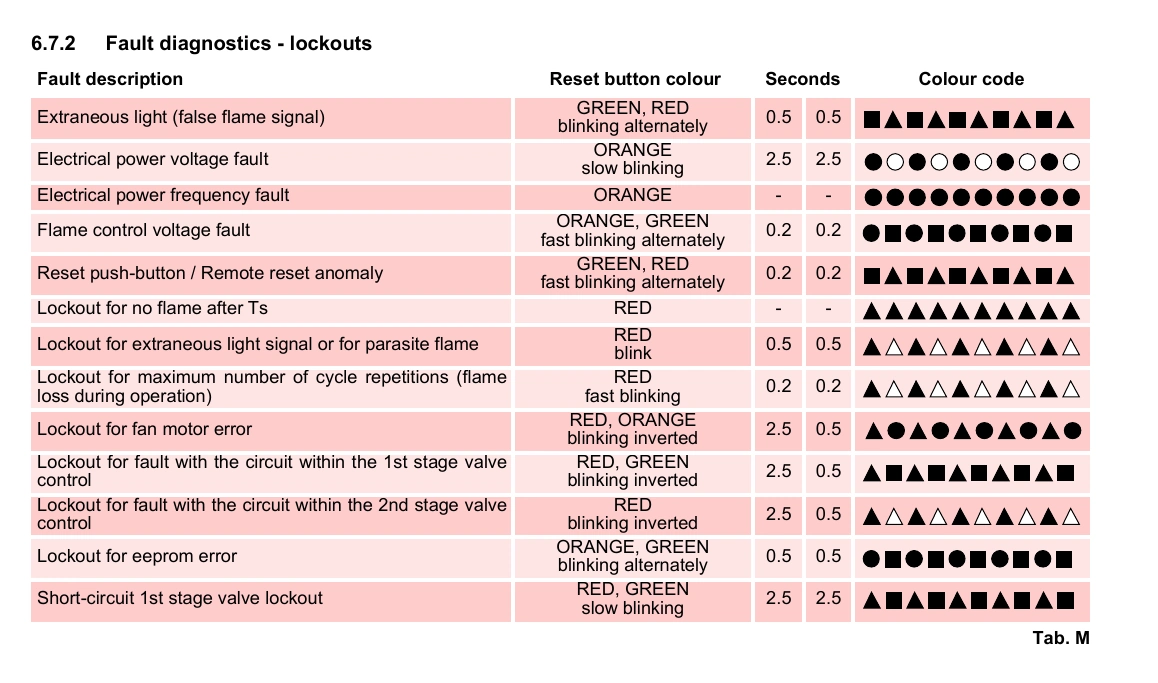
Swipe the table to see all columns →
| Signal | Timing | Meaning |
|---|---|---|
| Green / red | 0.5 / 0.5 s alternating | Unwanted light/flame signal |
| Orange | 2.5 s on / 2.5 s off | Supply-voltage fault |
| Orange | Steady | Supply-frequency fault |
| Orange / green | 0.2 / 0.2 s alternating | Control-box voltage fault |
| Green / red | 0.2 / 0.2 s alternating | Local or remote reset anomaly |
| Red | Steady | No flame within the safety time; lockout |
| Red | 0.5 s on / 0.5 s off | Lockout caused by extraneous light or parasitic flame |
| Red | 0.2 s on / 0.2 s off | Repeated flame-loss restart limit reached |
| Red / orange | 2.5 / 0.5 s alternating | Fan-motor fault lockout |
| Red / green | 2.5 / 0.5 s alternating | First-stage oil-valve control-circuit fault |
| Red | 2.5 s on / 0.5 s off | Second-stage oil-valve control-circuit fault |
| Orange / green | 0.5 / 0.5 s alternating | EEPROM fault lockout |
| Red / green | 2.5 / 2.5 s alternating | First-stage oil-valve short-circuit lockout |
For example, alternating red/green at 2.5 seconds per colour indicates a first-stage oil-valve short circuit in this RGD table. In the RS5D manual 20141174 rev.6, the same timing identifies an air-pressure-switch condition. Always select the matching manual.
LFL1.333RL: read the programme indicator
The RS 310–610/M BLU manual describes a rotating indicator visible through the control’s lockout window. Its stopping symbol identifies the interrupted programme stage; it is not a blink-count display.
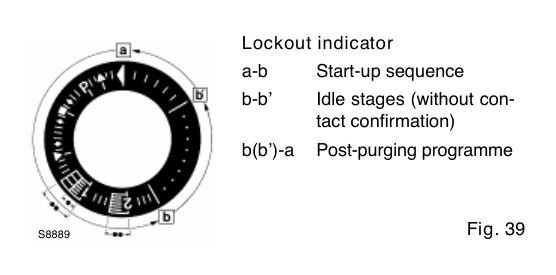

Swipe the table to see all columns →
| Indicator position | Stage / check direction |
|---|---|
| Start position (▶) | Starting prevented or lockout before start: supply, safety/fuel permissives, motor and closed-position confirmation. |
| Maximum-air position (▲) | Sequence stops at maximum damper opening: check actuator/cam position confirmation. |
| P | Air pressure not proved: check airflow, sensing tube and pressure-switch response. |
| Solid square (■) | Flame-detection circuit check failure. |
| Minimum-air position (▼) | Sequence remains in purge: check the minimum-position confirmation contact. |
| 1 | End of first safety time: distinguish failure to ignite from flame present but not detected. |
See the RS 310/M BLU product page for burner information and model-specific parts enquiries.
REC27.100A2: record the error and diagnostic codes
The RS 50/E MZ display alternates an error code with a diagnostic code. Record both: error 12 with diagnostic 0 is a different condition from error 12 with diagnostic 1.
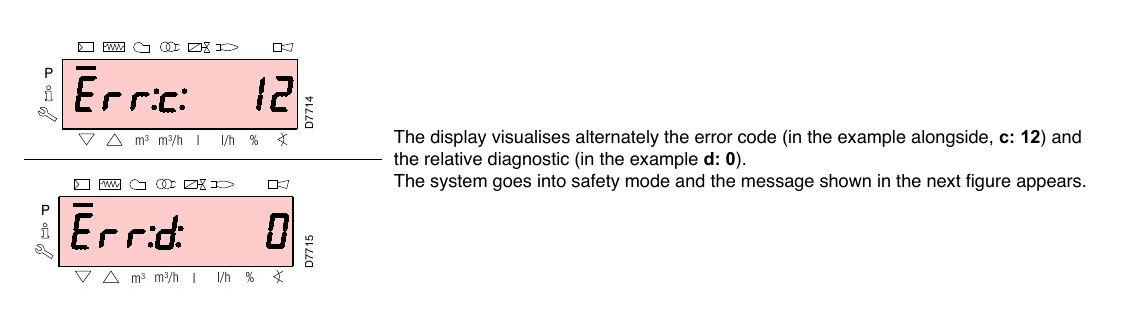
Swipe the table to see all columns →
| Error / diagnostic | Meaning / check direction |
|---|---|
| 2 / 4 | No flame at the end of TSA1: fuel, ignition and flame detection. |
| 3 / 0; 3 / 1; 3 / 4 | Air-pressure switch off; switch on; air-pressure signal present at start with lockout alarm, respectively. |
| 4 / 0; 4 / 1; 4 / 2 | Extraneous light during start-up; during switch-off; during start-up with lockout alarm, respectively. |
| 7 / 3 | Flame loss. |
| 12 / 0 | Valve proving: V2 leakage. With CPI supervision: CPI open. Identify which function is configured before testing. |
| 12 / 1 | Valve proving: V1 leakage. With CPI supervision: CPI closed. Identify which function is configured before testing. |
| 20 / 0 | Minimum fuel-pressure condition absent. |
| 21 / 0 | Maximum fuel-pressure limit exceeded. |
| 22 / 0 | Safety circuit open. |
| 70 / 26 | Modulation-curve points not defined. |
| 71 / 0, 1, 2 or 3 | Undefined standby, post-purge, pre-purge or ignition position, respectively. |
| 85 / bit 0 or bit 1 | Reference-position failure: bit 0 identifies the fuel actuator; bit 1 identifies the air actuator. Check connection, obstruction and load. |
| 86 / 0 | Fuel actuator does not reach the target position within tolerance. |
| 86 / bit 0 (value 1) | Open circuit at the fuel-actuator connection. |
| 87 / 0 | Air actuator does not reach the target position within tolerance. |
| 87 / bit 0 (value 1) | Open circuit at the air-actuator connection. |
Codes 85–87 also have diagnostic bit flags for reference, connection and mechanical-load faults. Preserve the complete diagnostic value when requesting service or an actuator. An undefined curve point is a commissioning issue; an open connection is a wiring issue.
LME71 on RX 700/850/1000 S/PV: Loc codes
Swipe the table to see all columns →
| Display | Meaning / check direction |
|---|---|
| Loc 2 | Flame not established by the end of the safety time: fuel, ignition, detector or burner setting. |
| Loc 3 | Air-pressure signal absent or lost within the required sequence. |
| Loc 4 | Extraneous light during start-up. |
| Loc 5 | Air-pressure switch remains in its working state; switch timing/state fault. |
| Loc 6 | Actuator fault: obstruction, connection or adjustment. |
| Loc 7 | Too many flame losses during operation; repetition limit reached. |
| Loc 10 | Wiring, internal-control or output-contact fault. |
| Loc 12 | Valve 1 fails the leakage test. |
| Loc 13 | Valve 2 fails the leakage test. |
| Loc 14 | Valve-closure proof (POC) fault. |
| Loc 20 | Minimum-gas-pressure switch open. |
| Loc 22 | Safety circuit open, including maximum-gas-pressure or safety-limit inputs. |
| Loc 60 | 4–20 mA input below 4 mA: inspect signal source and wiring. |
| Loc 83 | PWM fan fails to reach the target speed in time or moves outside the allowed speed tolerance. |
| Loc 139 | Program module not detected. |
| Loc 167 | Manual lockout. |
| Loc 225 | PWM conditions exceed the specified purge or ignition limits. |
| Loc 226 | Invalid fan-speed parameter relationship, including low-fire speed above high-fire speed or a zero required speed. |
| Loc 227 | One or more fan parameters exceed their permitted range. |
Loc 138 is a successful restore indication in this manual, not a component-failure diagnosis. Loc 167 records manual locking. For PWM faults, distinguish incorrect speed parameters from failure of the fan to achieve a valid target.
Back to controller selection ↑
Choose the replacement after identifying the failed component
Keep the burner model and existing component reference together. A flame-failure code can result from a fuel, ignition or detector fault; it does not by itself justify a replacement control. For an oil nozzle, match flow rating, spray angle and pattern. For a detector, match the sensing type and controller application. For a valve coil or actuator, retain its complete electrical and mechanical reference.
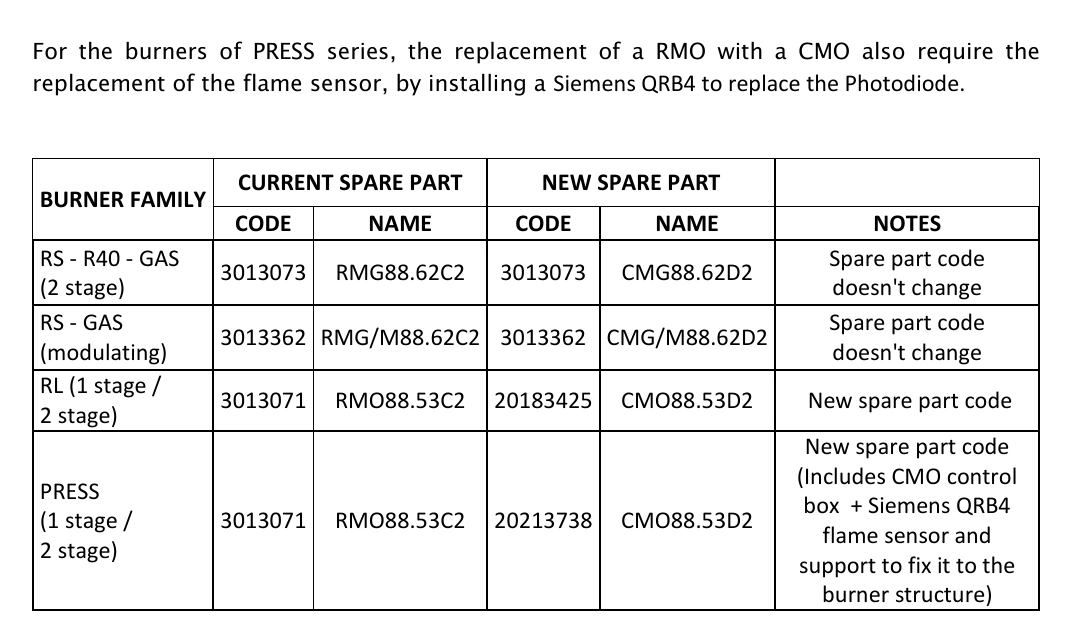
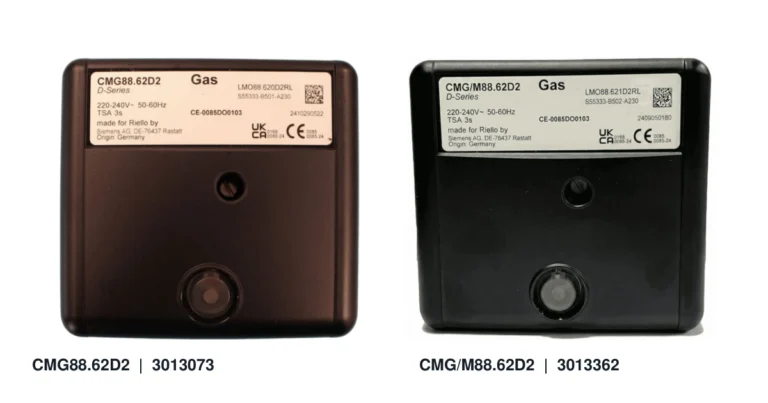
RMG to CMG: two distinct replacements
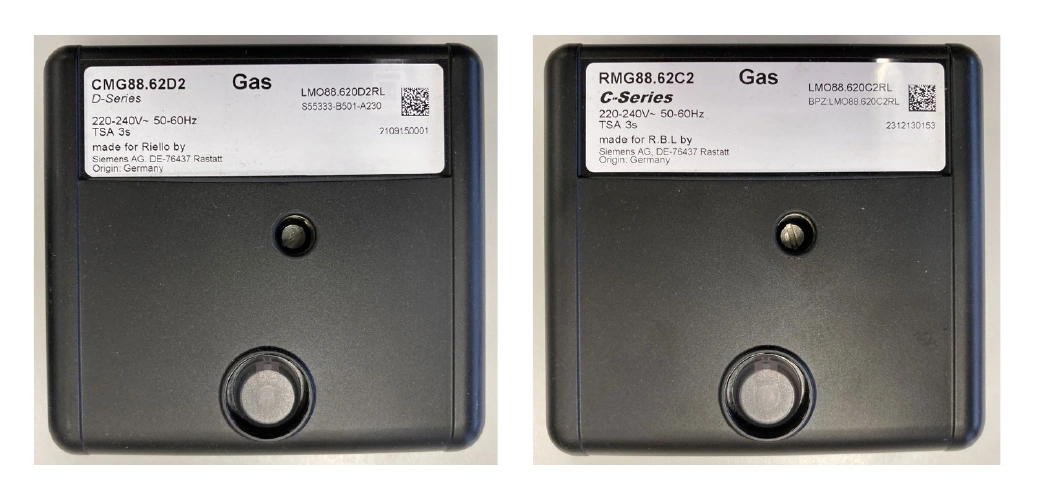
Swipe the table to see all columns →
| Application | Original control | Replacement / part code |
|---|---|---|
| RS / R40 / GAS, two-stage | RMG88.62C2 | CMG88.62D2 — 3013073 |
| RS / GAS, modulating | RMG/M88.62C2 | CMG/M88.62D2 — 3013362 |
| RL, one/two-stage | RMO88.53C2 — 3013071 | CMO88.53D2 — 20183425 |
| PRESS, one/two-stage | RMO88.53C2 — 3013071 | CMO88.53D2 kit — 20213738; includes QRB4 and mounting support |
The two gas-control replacements are listed separately: CMG88.62D2 and CMG/M88.62D2. Retain the /M distinction. This replacement notice establishes the old/new part relationship; use the diagnostic instructions for the control actually fitted.
PRESS: the CMO replacement includes a detector change
Riello specifies kit 20213738 for the PRESS replacement covered by this notice. It includes the CMO88.53D2 control, a Siemens QRB4 detector and its mounting support. Ordering a QRB4 detector alone does not supply that complete conversion kit.