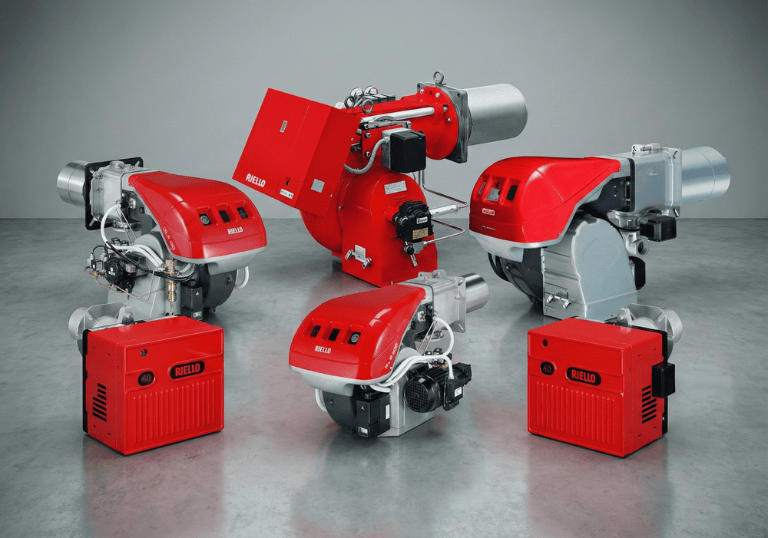
A 2 t/h steam boiler needs a burner. You open a catalogue and find several models that look large enough. The temptation is to choose one with a little extra capacity and move on to the price.
That extra capacity can be the wrong kind of margin. The burner also has to overcome the boiler’s furnace resistance and run steadily when steam demand falls. A model that meets the peak load but cannot turn down far enough may spend the quieter part of the day starting and stopping.
We will work through that 2 t/h boiler below, from the heat calculation to a Riello shortlist. The same questions apply to other boilers and process heaters, although the heat balance and combustion-chamber requirements change with the application.
Start with the equipment being heated
The boiler or furnace specification is the starting point. If its manufacturer gives a rated fuel heat input, use that figure and the conditions attached to it. A useful-output rating needs one more step: allowing for the heat that does not reach the water, oil, air or product.
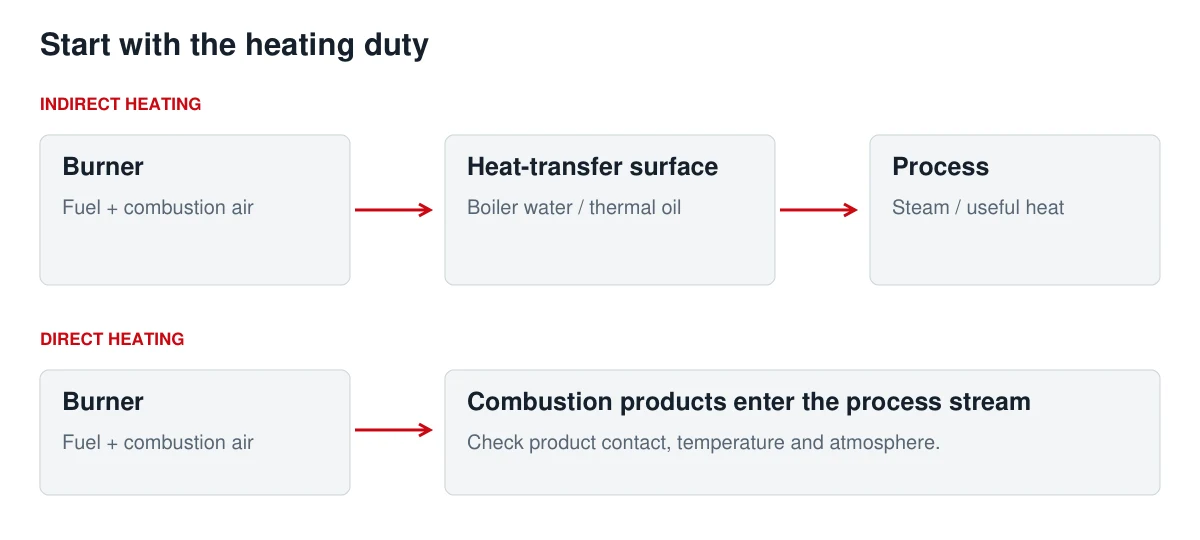
For a steam boiler, the calculation depends on steam production, steam condition and feedwater temperature. For a hot-water or thermal-oil heater, it depends on flow and the required temperature rise. A direct-fired process adds another consideration: the combustion products enter the process stream, so the atmosphere, exhaust arrangement and contact with the product matter as well as the heat duty.
Record the lowest sustained demand alongside the maximum. A replacement burner’s old nameplate is useful, but the plant may no longer operate at the load for which that burner was originally selected.
Sizing a 2 t/h steam boiler
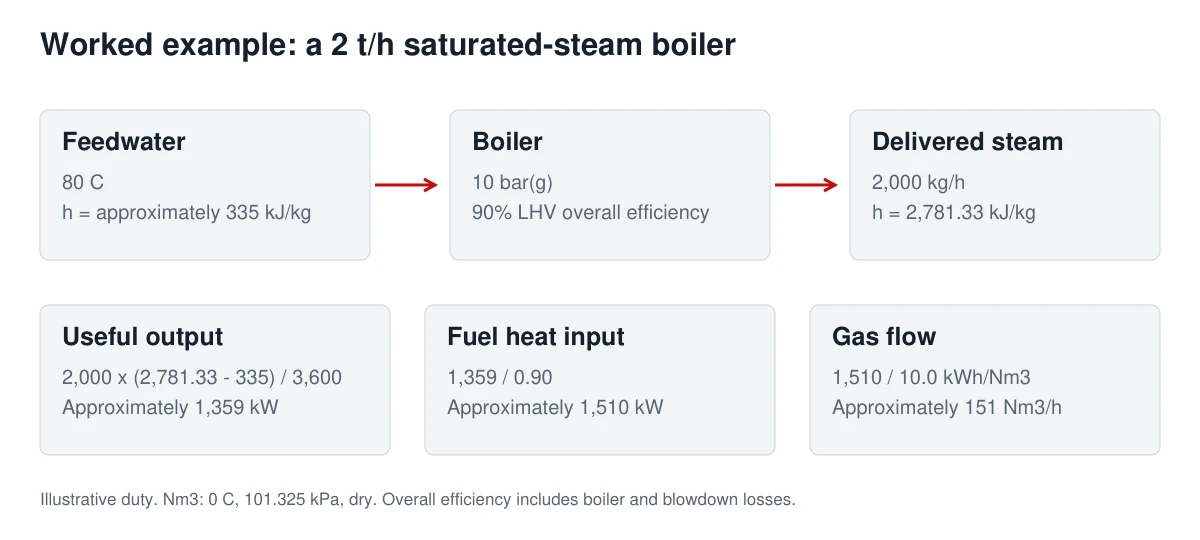
Take a natural-gas boiler producing 2,000 kg/h of dry saturated steam at 10 bar(g), with feedwater entering at 80°C. During low production, steam demand falls to 600 kg/h. These are the working assumptions for our example:
| Input | Example value |
|---|---|
| Maximum / minimum steam demand | 2,000 / 600 kg/h |
| Steam condition | Dry saturated steam at 10 bar(g) |
| Feedwater temperature | 80°C |
| Steam / feedwater enthalpy | 2,781.33 / approximately 335 kJ/kg |
| Overall boiler efficiency | 90%, on a lower-heating-value basis |
| Natural-gas lower heating value | 10.0 kWh/Nm³ |
The 2 t/h figure here is actual steam production. If a boiler is rated in equivalent evaporation “from and at 100°C”, that rating needs converting to the intended steam and feedwater conditions first. For this calculation, the enthalpy rise of each kilogram of water is 2,781.33 − 335 kJ. Multiplying by the hourly steam production gives the useful output:
Useful output
2,000 × (2,781.33 − 335) ÷ 3,600 = 1,359 kW
Required fuel heat input
1,359 ÷ 0.90 ≈ 1,510 kW
Maximum gas flow
1,510 ÷ 10.0 ≈ 151 Nm³/h
At the lower demand of 600 kg/h, using the same efficiency gives approximately 453 kW of fuel input. So the burner requirement is now clearer: roughly 453–1,510 kW, or a 3.33:1 load ratio. Simply asking for “a 1.5 MW burner” would lose the low-load part of that specification.
The assumed 90% is the boiler’s fuel-to-delivered-steam efficiency, including boiler and blowdown losses. Actual part-load efficiency will refine the 453 kW result. If the supplied efficiency excludes blowdown, its heat load belongs in the calculation separately.
The fuel and efficiency figures also need to use the same heating-value basis. Lower heating value (LHV) excludes the heat recovered by condensing water vapour in the combustion products; higher heating value (HHV) includes it. Here both figures use LHV, and Nm³ means dry gas at 0°C and 101.325 kPa. Those reference conditions should accompany the gas supplier’s heating value.
A different fuel changes more than this one number. Raw biogas contains carbon dioxide and other constituents as well as methane; LPG needs the appropriate burner configuration and supply-pressure data. For oil, start with mass flow and heating value in kWh/kg, then use the oil density if the supply needs specifying in litres per hour.
From calculated duty to a burner model
For this boiler, suppose the specification calls for a low-NOx gas burner with electronic air/fuel control. Three Riello RS/E BLU models illustrate why both ends of the operating range matter:
| Burner | Published output | Fit for the example duty |
|---|---|---|
| RS 120/E BLU | 300/600–1,300 kW | Too small at full load: 1,300 kW is below the required 1,510 kW. |
| RS 160/E BLU | 300/930–1,860 kW | Covers the required outputs; next check the firing-rate diagram. |
| RS 200/E BLU | 570/1,375–2,400 kW | Its 570 kW minimum is above the 453 kW low-load requirement. |
RS 160/E BLU is the candidate to examine further. RS 200/E BLU has more peak capacity, but that does not help the boiler at its lowest sustained demand. Adding a routine percentage to the calculated duty could push the selection in the wrong direction; any extra capacity should have a defined purpose, such as an additional startup duty.
The three-part catalogue ranges make sense alongside the firing-rate diagram. Riello distinguishes the working field used to select the burner from its extended modulation range. The plot adds the other half of the match: how much combustion-chamber pressure the burner can overcome at a given heat input.
Assume, for illustration, that this boiler needs 4.0 mbar at full load and 0.5 mbar at minimum load. Point A is then 1,510 kW at 4.0 mbar, and point B is 453 kW at 0.5 mbar. On the RS 160/E-EV BLU diagram, A sits in the solid selection field and B in the dashed modulation field.
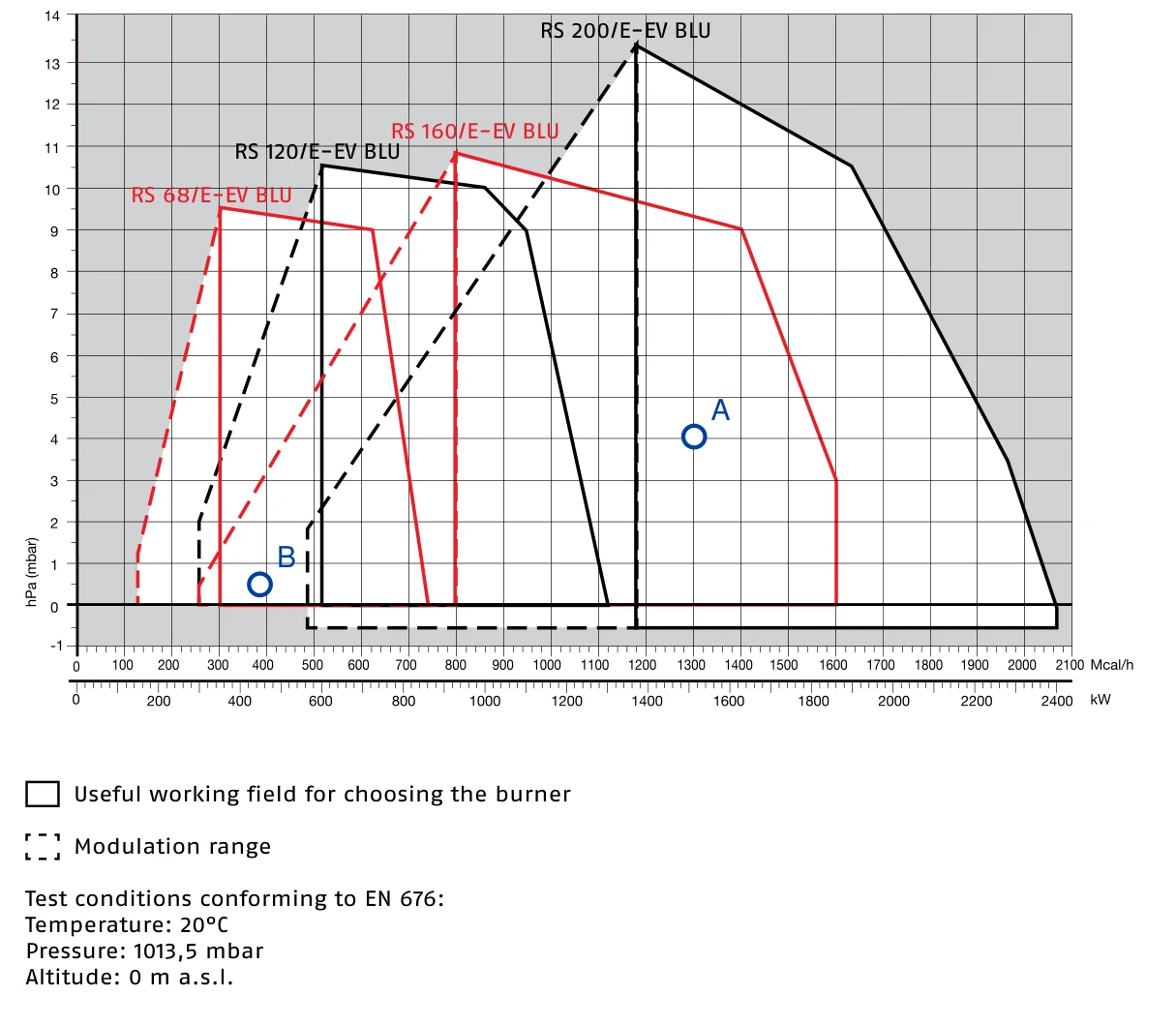
Those points support the shortlist. To complete the match, use the boiler manufacturer’s resistance curve across the operating range, including the connected flue arrangement, and the correct burner head and operating conditions. The boiler’s 10 bar(g) steam pressure is on the water side; the mbar values on this plot describe furnace backpressure.
The RS 160/E BLU specifications and technical document are available on the product page. Before turning that candidate into an order, the gas supply and installation still need to suit it.
Can the gas supply deliver 151 Nm³/h?
A gas-pressure reading with the burner stopped cannot answer that question. What matters at full load is the pressure available while the required flow is being delivered. That pressure has to cover the losses through the supply pipe, filter, regulator, safety valves, burner gas path and combustion head, together with the furnace pressure.
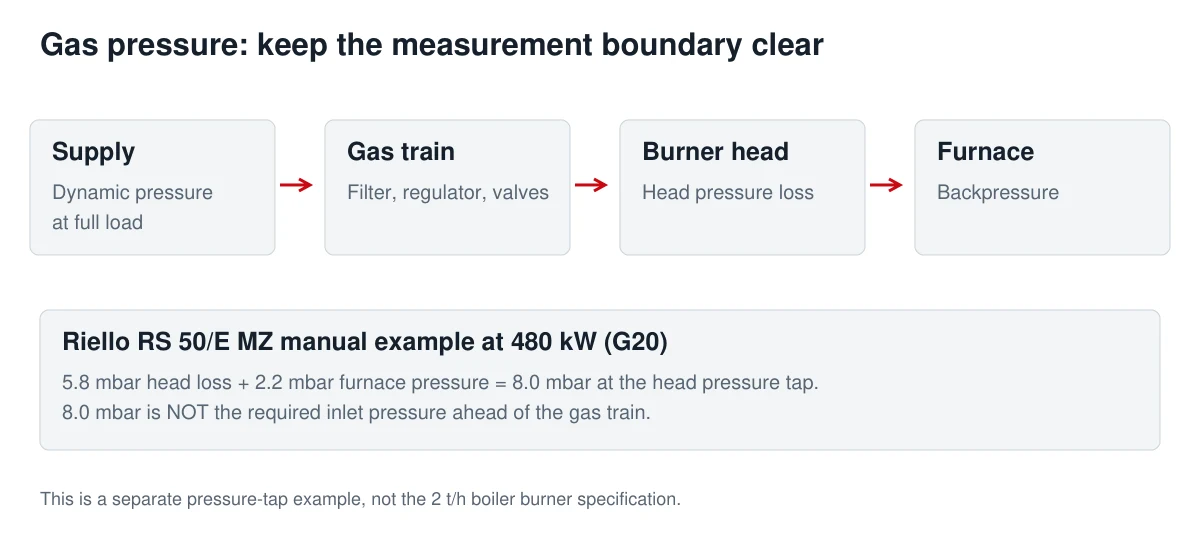
The measurement point is easy to overlook. Riello’s RS 50/E MZ manual gives a useful, separate example: at 480 kW on G20 gas, the head requires 5.8 mbar and the furnace pressure is 2.2 mbar. The resulting 8.0 mbar is the pressure at the head tap. An upstream gas supply still has the intervening losses to overcome.
For our 2 t/h boiler, take the calculated 151 Nm³/h and the site’s minimum dynamic inlet pressure to the selected burner’s gas-train tables. Their measurement boundary tells you which losses are already included. The final train also needs a suitable regulator range, maximum inlet-pressure rating, connection, valve-proving arrangement and any required adaptor. Matching pipe diameter alone leaves most of that work undone.
How the burner follows a changing load
Our boiler has a sustained low-load requirement of about 453 kW. A burner whose minimum firing rate is higher will have to cycle when demand stays at that level. Each restart brings another start sequence and purge; the resulting cycling and standby losses depend on the plant and operating pattern.
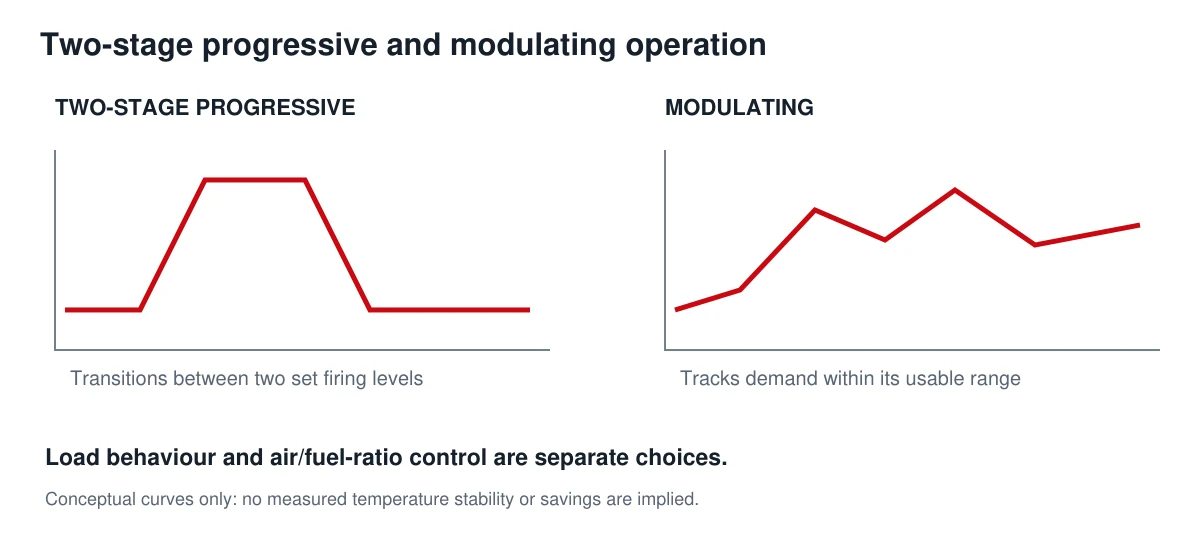
The first control choice is how output follows demand. On/off gives one firing rate. Two-stage operation provides two settings, plus off; the low setting is not universally 50% of the high setting. Progressive two-stage control moves smoothly between those two levels. Continuous modulation follows demand through the usable range, rather than responding at just two demand levels.
For the example, the specification therefore needs modulation over the required load range, together with the regulation needed to follow steam pressure. This is where a quotation needs to name the pressure regulator/control function and steam-pressure probe, not just the burner model.
There is a second choice within that: how air and fuel move together. Mechanical linkage or cam control coordinates them mechanically. Electronic cam control uses separate actuators and programmed curves. Pneumatic ratio control regulates fuel in relation to air pressure. These describe the air/fuel arrangement; the ordered configuration still determines whether the burner operates in stages or modulates continuously.
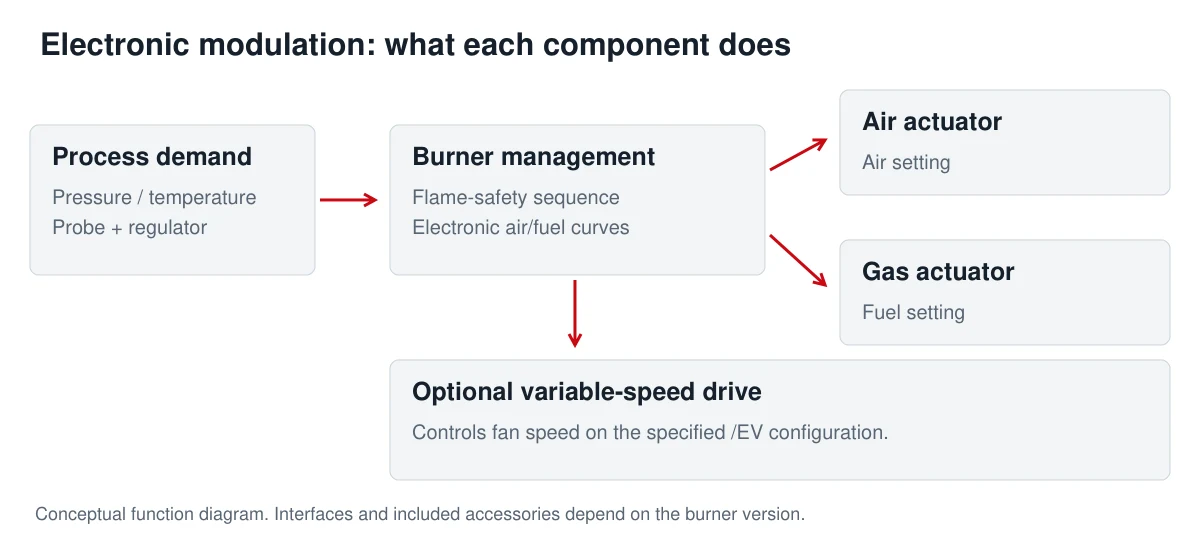
Riello’s GS/M leaflet is a good example of that distinction. The basic burner operates in progressive two-stage mode, with additional regulation components for modulation. The RS/E-EV BLU leaflet also specifies the appropriate regulator and probes for modulating operation. On relevant /EV versions, a variable-speed drive adds fan-speed control; its benefit depends on the load profile and configuration.
With dual fuel, read the operating mode for each fuel separately. Riello’s RLS 68–160/M MX leaflet describes two-stage oil operation and progressive/modulating gas operation with the corresponding regulation. A gas-side control range should not be assumed for the oil side.
Will the selected burner fit the boiler and the site?
The firing-rate diagram does not show the boiler door, the combustion chamber or the space available for maintenance. Those come from the installation drawings. Chamber length and diameter, flame geometry, head insertion and the mounting arrangement need to work together.
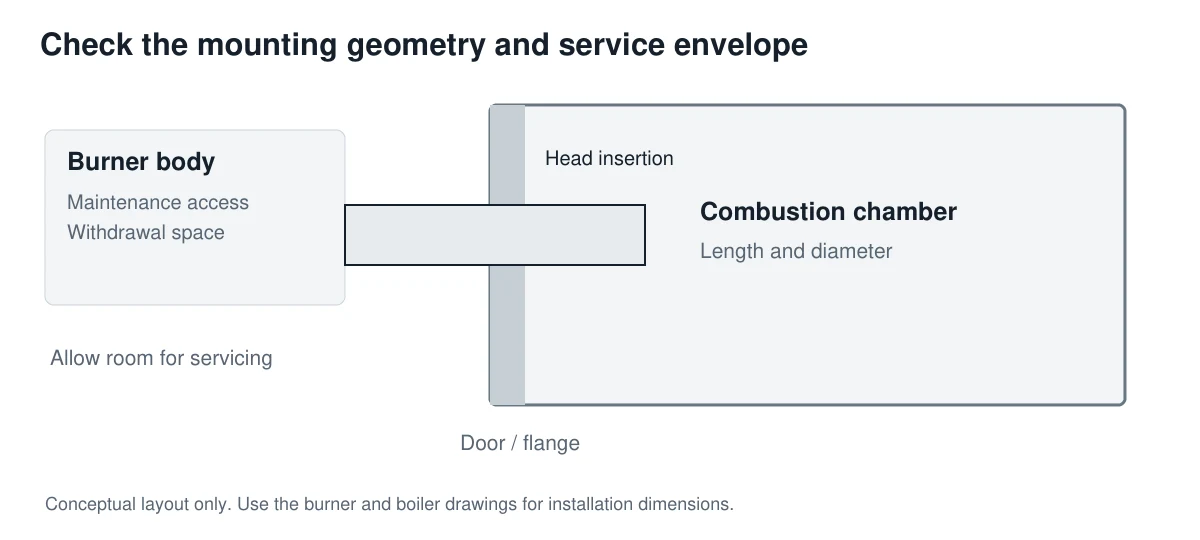
| Installation detail | Information to put on the enquiry |
|---|---|
| Boiler and mounting | Chamber dimensions, refractory/door arrangement, door thickness, head insertion and flange/bolt pattern. |
| Access | Gas-train position and room to withdraw the burner or head for service. |
| Electrical supply | Voltage, phase, frequency and auxiliary/control voltage. |
| Site conditions | Altitude, combustion-air and ambient temperatures, ventilation, dust and moisture exposure. |
| Emissions requirement | NOx and CO limits, fuel, units, reference oxygen, dry/wet basis and permit/test conditions. |
Packed dimensions are useful for freight, but they do not describe the installation envelope. Likewise, an IP rating describes enclosure protection; outdoor exposure, washing and hazardous-area suitability require their own assessment. The electrical version must suit the full burner assembly, including its motor, fan and controls.
Altitude and hot combustion air can also change the working field. Riello provides temperature and altitude correction procedures in its manuals, including the RS 50/E MZ manual referenced below. Use the procedure for the selected model rather than a general percentage allowance.
For emissions, send the actual project limit. “Low NOx” identifies a product characteristic, while compliance depends on the burner/boiler combination and the stated measurement conditions. Values in mg/kWh and mg/Nm³, or at different reference oxygen levels, are not directly comparable.
What the quotation should include
At this point the example has a useful shortlist: RS 160/E BLU, approximately 453–1,510 kW input, with the regulator and steam-pressure probe needed for modulation. The actual boiler resistance, chamber drawing and gas-supply pressure are what settle the gas train and installation configuration.
Ask for the scope of supply alongside the price. For a gas burner, that means identifying the matched gas train, adaptor, valve proving where required, and regulation equipment. An oil-burner quotation needs the pump/nozzle arrangement, filtration and installation accessories. A dual-fuel package needs both circuits and its changeover arrangement. Electrical version, head configuration, commissioning, manuals and spare-parts references belong in all three.
For an initial enquiry, send the boiler or furnace specification, fuel data, maximum and minimum demand, available fuel pressure and site conditions. Attach the chamber and mounting drawing if available. For a replacement, add the burner and boiler nameplates; if a suffix is unfamiliar, the Riello model-number guide explains the designation. Include the quantity, delivery destination and equipment you expect in the quoted package.
If the reason for replacing the burner is repeated lockout, diagnose that separately before choosing a larger model. The Riello lockout and fault-code guide covers the starting sequence and common faults.